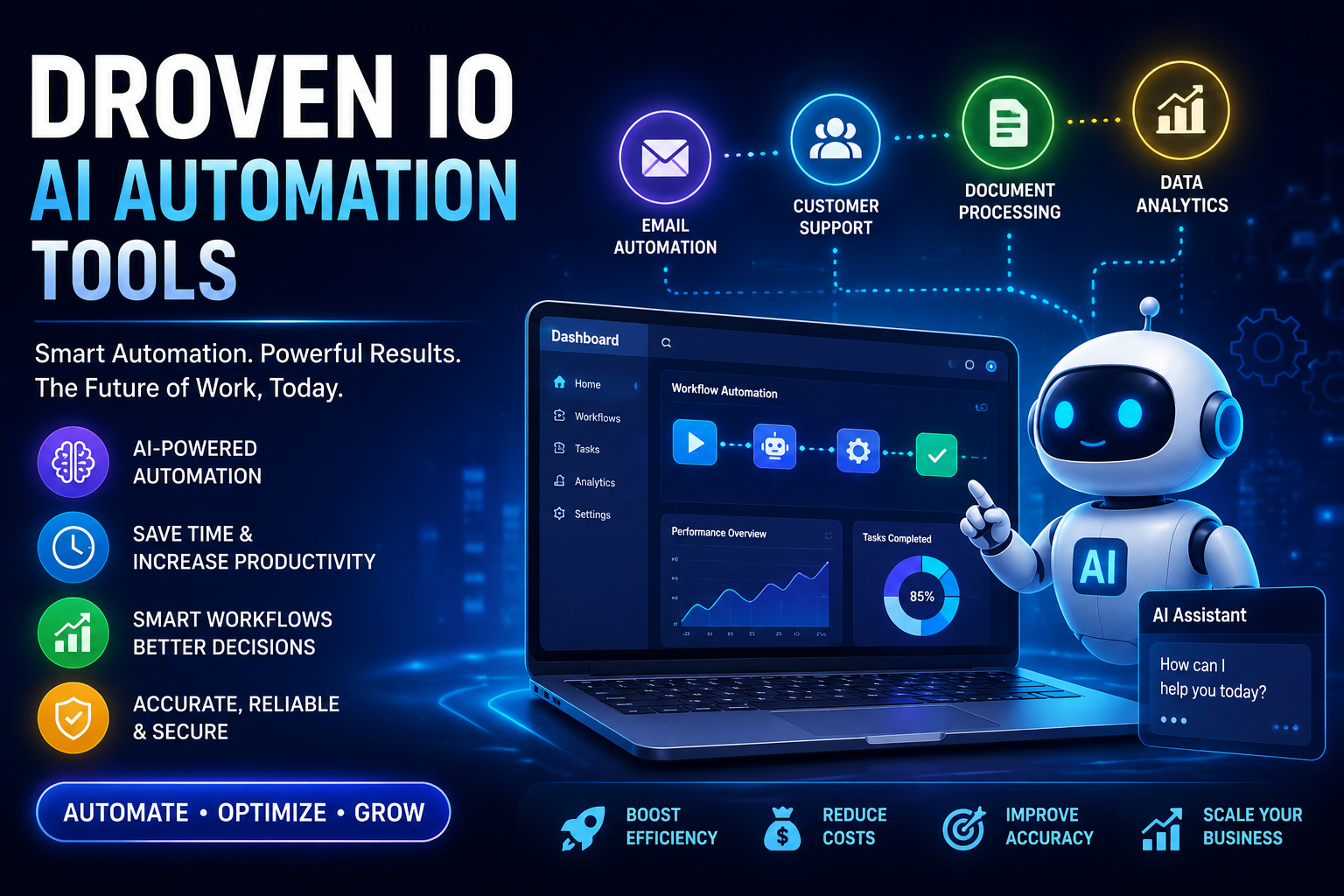
Droven io AI Automation Tools: 10 Powerful Smart Features That Transform Modern Work
Droven io AI Automation Tools
Droven io AI Automation Tools are becoming an important topic among businesses, freelancers, startups, and digital professionals looking to automate repetitive tasks. Artificial intelligence has changed the way companies operate, helping them save time, reduce costs, and improve efficiency. Instead of spending hours on manual work, organizations now rely on AI-powered automation platforms that can perform complex workflows within seconds.
Whether you manage marketing campaigns, customer support, sales operations, content creation, or data processing, AI automation can significantly improve productivity. Droven io AI Automation Tools aim to simplify business operations by combining automation with intelligent decision-making. This guide explains everything you need to know about Droven io AI Automation Tools, including their features, benefits, applications, challenges, future trends, and frequently asked questions.
| Feature | Details |
|---|---|
| Focus Keyword | Droven io AI Automation Tools |
| Category | Artificial Intelligence |
| Primary Purpose | Business Process Automation |
| Best For | Businesses, Freelancers, Startups |
| Main Benefits | Productivity, Cost Savings, Speed |
| Technology | Artificial Intelligence & Workflow Automation |
| Industries | Marketing, Healthcare, Finance, Retail, Education |
| Learning Curve | Beginner to Advanced |
| Automation Level | High |
| Future Potential | Very Strong |
What Are Droven io AI Automation Tools?
Droven io AI Automation Tools refer to AI-driven solutions designed to automate repetitive digital workflows while improving accuracy and efficiency. Instead of requiring employees to manually perform routine tasks, these tools allow artificial intelligence to complete much of the work automatically.
Businesses often deal with repetitive operations such as data entry, email responses, scheduling, report generation, customer support, social media management, invoice processing, and document organization. AI automation reduces the time required for these activities while minimizing human error.
Modern automation tools combine several advanced technologies, including:
- Artificial Intelligence
- Machine Learning
- Natural Language Processing (NLP)
- Predictive Analytics
- Intelligent Workflow Management
- Cloud Computing
Together, these technologies create smarter automation systems capable of learning and improving over time.
Why AI Automation Is Becoming Essential
Companies worldwide face increasing competition. Customers expect faster responses, personalized services, and better experiences. Manual work often slows operations and increases costs.
AI automation solves many of these challenges by handling repetitive tasks without fatigue.
Key reasons businesses adopt AI automation include:
- Increased efficiency
- Lower operational costs
- Improved customer experience
- Better decision-making
- Reduced human errors
- Faster project completion
- Enhanced scalability
Organizations that embrace AI automation often gain a competitive advantage because employees can focus on strategic work rather than repetitive administrative tasks.
Core Features of Droven io AI Automation Tools
One reason Droven io AI Automation Tools attract attention is the wide variety of automation capabilities they may offer.
Some common features include:
Intelligent Workflow Automation
Complex workflows involving multiple steps can run automatically without manual intervention.
AI Content Assistance
AI helps generate reports, summaries, emails, and other business documents.
Automated Customer Support
Virtual assistants and AI chatbots respond to customer inquiries around the clock.
Smart Scheduling
Meetings, appointments, reminders, and calendars are managed automatically.
Data Processing
Large datasets can be organized, analyzed, and categorized within minutes.
Document Management
AI extracts information from invoices, contracts, receipts, and forms.
Analytics Dashboard
Businesses receive performance insights through interactive reports and real-time analytics.
Task Prioritization
Artificial intelligence identifies high-priority work and recommends efficient scheduling.
Integration Support
Automation platforms often integrate with CRM systems, email platforms, cloud storage, accounting software, and productivity tools.
Machine Learning Improvements
The system continuously improves based on previous workflow data.
How AI Automation Works
AI automation follows a structured process.
First, users define a workflow.
Next, artificial intelligence analyzes the process.
Then, automation rules determine what actions should occur.
Machine learning algorithms monitor outcomes.
Finally, the AI improves future performance based on collected data.
This continuous learning cycle makes automation increasingly efficient over time.
Benefits of Droven io AI Automation Tools
Businesses invest in automation because the benefits extend beyond simple time savings.
Higher Productivity
Employees complete more work because repetitive tasks require little manual effort.
Reduced Costs
Automation decreases labor expenses and minimizes costly human mistakes.
Better Accuracy
AI follows predefined rules consistently, reducing errors.
Faster Customer Service
Customers receive instant responses through automated support systems.
Improved Decision Making
AI analyzes large datasets to identify useful patterns.
24/7 Operations
Unlike human workers, AI systems continue operating around the clock.
Employee Satisfaction
Staff members spend less time on repetitive work and more time on creative projects.
Scalability
Growing businesses can automate increasing workloads without dramatically expanding staff.
Industries Using AI Automation
AI automation has expanded into nearly every industry.
Healthcare
Hospitals automate patient scheduling, billing, medical records, and appointment reminders.
Finance
Banks automate fraud detection, loan processing, customer verification, and compliance monitoring.
Retail
Retailers automate inventory tracking, order processing, and personalized recommendations.
Marketing
Marketing teams automate email campaigns, social media posting, audience analysis, and reporting.
Human Resources
HR departments automate recruitment, resume screening, employee onboarding, and payroll management.
Education
Schools automate grading, student communication, scheduling, and learning recommendations.
Manufacturing
Factories automate production monitoring, predictive maintenance, and quality control.
AI Automation for Small Businesses
Small businesses often assume automation is only for large corporations.
In reality, AI automation benefits smaller organizations even more because limited staff can accomplish significantly more work.
Examples include:
- Automatic invoice creation
- Customer email responses
- Appointment scheduling
- Inventory updates
- Marketing campaigns
- Lead management
- Sales reporting
Even basic automation can save dozens of hours every month.
Marketing Automation with AI
Marketing departments benefit greatly from AI-powered automation.
Tasks include:
- Email personalization
- Social media scheduling
- SEO analysis
- Content recommendations
- Customer segmentation
- Performance reporting
- Lead scoring
Instead of manually managing every campaign, marketers can focus on strategy and creativity.
Customer Service Automation
Modern customers expect immediate assistance.
AI-powered support systems provide:
- Live chat
- Automated FAQs
- Order tracking
- Account management
- Complaint routing
- Ticket prioritization
This improves customer satisfaction while reducing support costs.
Sales Process Automation
Sales teams often spend valuable time updating spreadsheets and customer records.
AI automation can:
- Track leads
- Update CRM systems
- Schedule follow-ups
- Score potential customers
- Generate proposals
- Analyze sales performance
Sales professionals then spend more time closing deals.
Workflow Automation
Business workflows involve multiple repetitive actions.
For example:
Customer inquiry → CRM update → Sales notification → Follow-up email → Invoice generation → Payment reminder
Instead of completing each step manually, AI automation performs them automatically.
AI and Data Analysis
Businesses collect enormous amounts of information every day.
AI automation helps analyze:
- Sales data
- Customer behavior
- Website traffic
- Marketing performance
- Employee productivity
- Financial reports
These insights help managers make smarter decisions.
Security Considerations
AI automation handles sensitive business information.
Organizations should prioritize:
- Strong passwords
- Multi-factor authentication
- Data encryption
- Regular software updates
- Role-based access controls
- Backup strategies
Security remains essential for protecting customer and company data.
Challenges of AI Automation
Although AI automation offers many advantages, some challenges remain.
Initial Setup
Complex workflows may require planning before implementation.
Employee Training
Staff members need time to understand automation systems.
Integration Issues
Older software sometimes requires customization.
Data Quality
Poor data can reduce automation accuracy.
Ongoing Monitoring
Automation still requires occasional supervision to ensure quality.
Best Practices for Successful Automation
Organizations achieve better results by following proven strategies.
Start with simple workflows before expanding.
Document business processes carefully.
Train employees.
Monitor automation performance regularly.
Update workflows as business needs evolve.
Measure return on investment.
Maintain strong cybersecurity practices.
Future of Droven io AI Automation Tools
Artificial intelligence continues advancing rapidly.
Future automation platforms are expected to include:
- More intelligent decision-making
- Better predictive analytics
- Voice-controlled workflows
- Autonomous business operations
- Personalized AI assistants
- Improved natural language understanding
- Advanced robotic process automation
- Smarter collaboration features
As AI becomes more sophisticated, automation will continue transforming nearly every industry.
Why Businesses Should Consider AI Automation
Companies that delay adopting AI automation may struggle to compete with organizations using faster, smarter workflows.
Automation helps businesses:
- Reduce operational costs
- Improve customer satisfaction
- Increase employee productivity
- Make faster decisions
- Scale efficiently
- Improve overall profitability
Rather than replacing employees, AI often enhances human productivity by handling repetitive tasks while people focus on innovation and strategic thinking.
Conclusion
Droven io AI Automation Tools represent the growing shift toward intelligent business automation. By combining artificial intelligence with workflow management, these tools help organizations automate repetitive tasks, improve productivity, reduce operational costs, and enhance customer experiences.
From marketing and customer support to finance, healthcare, education, and manufacturing, AI automation continues transforming industries worldwide. While implementation requires planning and ongoing optimization, the long-term benefits often outweigh the initial investment.
As artificial intelligence evolves over the coming years, Droven io AI Automation Tools and similar automation platforms are expected to become even more capable, enabling businesses of all sizes to work faster, smarter, and more efficiently.
Frequently Asked Questions (FAQs)
1. What are Droven io AI Automation Tools?
Droven io AI Automation Tools are AI-powered solutions designed to automate repetitive business workflows and improve operational efficiency.
2. Who can use Droven io AI Automation Tools?
Businesses, freelancers, startups, marketing agencies, educational institutions, healthcare providers, and enterprise organizations can benefit from AI automation.
3. What tasks can AI automation perform?
AI automation can manage emails, scheduling, customer support, data entry, reporting, document processing, workflow management, and analytics.
4. Are AI automation tools suitable for small businesses?
Yes. Small businesses often experience significant productivity improvements because automation reduces manual work.
5. Do AI automation tools replace employees?
Generally, AI supports employees by automating repetitive tasks, allowing them to focus on higher-value work.
6. Is AI automation secure?
Most modern AI automation platforms include encryption, authentication, and security controls, although organizations should also follow cybersecurity best practices.
7. Can AI automation integrate with existing software?
Many AI automation platforms integrate with CRM systems, cloud storage, accounting software, email services, and productivity applications.
8. What industries benefit the most?
Healthcare, finance, retail, education, manufacturing, marketing, logistics, and customer service all benefit significantly from AI automation.
9. Is coding required to use AI automation tools?
Many modern automation platforms provide no-code or low-code interfaces that allow beginners to build workflows without programming.
10. What is the future of AI automation?
The future includes smarter decision-making, predictive analytics, autonomous workflows, voice-controlled automation, and increasingly personalized AI assistants that further improve business efficiency.